


Port charges are one of the costs involved in clearing an imported car through a Nigerian port. They cover services such as cargo handling, delivery, storage, examination and documentation, with the amount determined by the services required and how the vehicle is handled.
In this guide, we’ll explain the main port charges in Nigeria, how terminal handling works, how the fees are calculated, and what to check for before your car arrives.
How Port Charges Work in Nigeria?
Port charges build up at different stages of clearance rather than appearing as one single fee.
The Nigerian Ports Authority charges for services covered by its port tariff. The terminal operator then charges for handling the vehicle within its facility, while the shipping line or its local agent may have separate fees connected to cargo release. Customs handles a different part by assessing and collecting import duties, taxes and levies.
This means a clearing bill can contain charges from several parties. An NPA fee is different from a terminal handling fee, just as a shipping-line release fee is different from Customs duty.
For example, an imported car may incur NPA charges when it enters the port, terminal charges as it is handled and prepared for release, and shipping-line charges before the cargo is released. If clearance takes longer than the free period, rent can then be added to the bill.
Customs duty and other vehicle-related taxes are calculated separately. This includes the vehicle import levy and Green Tax, which form part of the government’s import-related charges rather than the NPA’s port fees.
Understanding Nigeria’s Port and Terminal Structure
Nigeria’s port system is made up of several port complexes and privately operated terminals, and the terminal receiving a vehicle has a direct bearing on the charges attached to its handling.
The Lagos Port Complex in Apapa currently has 5 private terminal operators, while Tin Can Island Port Complex also has 5 operators handling different types of cargo and port activities. These include terminals such as ENL Consortium, Apapa Bulk Terminals, Sifax, Five Star Logistics, TICT and Ports and Terminal Multiservices.
This structure is important because terminal handling is not covered by one universal rate. When estimating port charges, you have to identify a specific terminal to tell you what charges will be applied to your vehicle.
Key Port Charges for Imported Vehicles
The charges that appear on a clearing bill will vary by shipment, but these are the main categories.
NPA Port Charges
The Nigerian Ports Authority charges for services connected to cargo moving through the port, including cargo dues, delivery, rent and throughput.
For vehicle cargo, the tariff uses CBM categories. A foreign-import vehicle up to 15 CBM, for example, attracts US$50.60 in cargo dues per unit. A vehicle between 16 and 25 CBM attracts US$83.95, while one above 25 CBM attracts US$281.75.
Handling is charged separately. A vehicle up to 15 CBM is charged ₦2,497 for direct delivery or ₦2,583 for indirect delivery, while a vehicle between 16 and 25 CBM is charged ₦2,775 to ₦2,907 per unit.

Throughput is another NPA charge. For vehicles, the tariff starts at US$4.82 for vehicles up to 15 CBM, rising to US$8.03 for 16–25 CBM and US$16.05 for vehicles above 25 CBM.
The NPA port tariff contains the full schedule of charges and the different rates applied to each category of cargo.
Terminal Handling Charges
Terminal handling covers the physical work involved in receiving and moving the vehicle within the terminal. This can include discharge, positioning, movement, delivery and preparing the vehicle for examination or release.
There is no single terminal handling rate across Nigerian ports because the terminals operate under their own tariffs. A vehicle handled at a terminal in Apapa, for example, is charged according to the tariff of that particular terminal.
This means the fees are separate from the NPA charges above and can form a significant part of the port bill.
Storage and Rent Charges
Rent is charged when a car remains at the port beyond the free period.
Under the NPA tariff, vehicles have 3 free days after completion of discharge. After that, the first rent period is ₦150 per day for a vehicle up to 15 CBM, ₦188 for a car between 16 and 25 CBM, and ₦375 for a vehicle above 25 CBM.
The rate increases after the first period. It rises to ₦900 per day for vehicles up to 15 CBM, ₦1,125 for 16 – 25 CBM, and ₦1,800 for vehicles above 25 CBM.
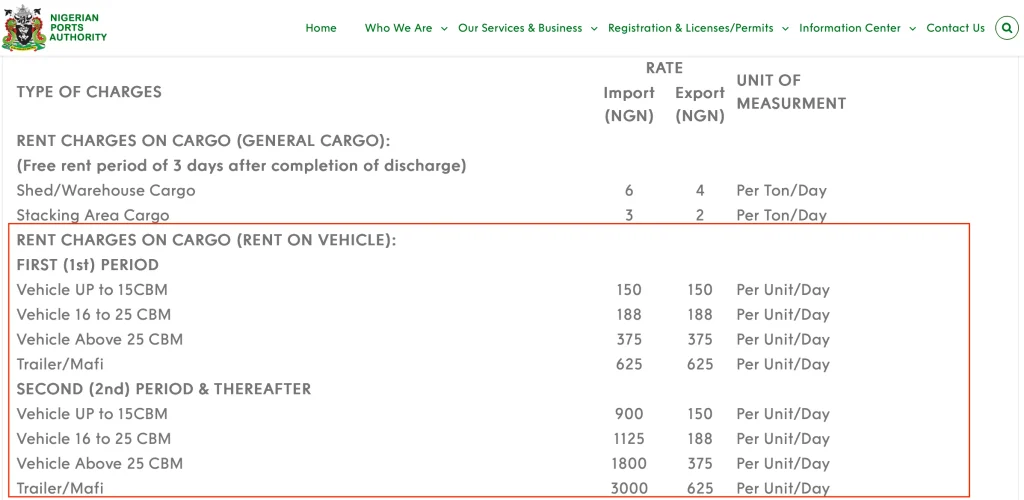
These charges can accumulate quickly when clearance is delayed. Payment delays can also contribute to higher storage and demurrage costs when funds needed to release cargo are not available on time.
Shipping-Line and Release Charges
Shipping-line charges are fees connected to the carrier’s handling and release of the cargo.
They can include documentation, delivery order and other release services. Unlike NPA charges, these are set by the shipping line or its local agent.
Because these fees are tied to the carrier and shipment, they are normally listed separately on the clearing bill rather than combined with port or Customs charges.
Examination and Related Handling
When Customs selects a car for examination, the car may have to be moved or positioned within the terminal before the inspection can take place.
The NPA tariff includes a ₦1,400 charge per document or examination for cargo services. Additional terminal handling may arise where the car needs to be moved or positioned for inspection.
This examination-related cost is separate from the Customs duty or tax assessed on the vehicle.
How Port Charges Are Calculated
Port charges are calculated according to the service being provided.
A delivery charge may be charged per vehicle, rent by the number of days the vehicle remains at the terminal, and documentation by the number of documents or invoices. Vehicle size can also place the cargo in a different tariff category.
This means the port bill is built from several individual charges rather than one flat port fee.
Factors That Can Increase Port Charges
The main factors that determine the charges are:
- Vehicle size: Larger vehicles can fall into higher tariff categories.
- Terminal: Different terminal operators have different services and tariffs.
- Shipping method: RoRo and containerised shipments require different handling processes.
- Services required: Examination, positioning, movement and delivery can result in additional service charges.
- Time at the port: Storage or rent charges can depend on how long the vehicle remains within the terminal.
Managing Port Costs During the Clearance Process
The first step is to confirm the port and terminal where the vehicle will be handled. The applicable NPA and terminal charges can then be established from the relevant tariff information.
The clearing agent should provide a breakdown of the expected costs. Customs duty, NPA charges, terminal handling, storage, shipping-line charges, agent fees and inland transport should be identifiable rather than presented as one unexplained amount.
Documentation should be checked before the vehicle arrives, and the funds required for clearance should be available when payments become due.
This preparation begins before the vehicle reaches Nigeria. An importer may need to pay an overseas auction platform, shipping company or other foreign vendor during the same transaction. Having a reliable way to pay foreign vendors can help keep those payments on schedule and prevent delays further along the import process.

Frequently Asked Questions
Do I need a clearing agent or can I clear my car myself?
Nigerian ports allow self clearing, but most importers use a licensed agent because there can be many documents and approvals involved. An experienced agent already knows the current terminal rates.
How long does it take to clear a car at Nigerian ports?
Clearance can take anywhere from a few days to a few weeks, depending on how quickly duty and charges are paid.
Can port charges be paid in installments?
No. A complete upfront payment is mandatory before cargo release or vessel clearance.