
If you’re an African importer paying vendors abroad, you’ve probably run into confusing terms like ACH, SWIFT, and wire transfer. Maybe your supplier asked you to send a wire. Maybe your payment was delayed, and nobody could explain why. Or maybe you’ve been paying high fees without realizing there was a better option.
What is an ACH Transfer?
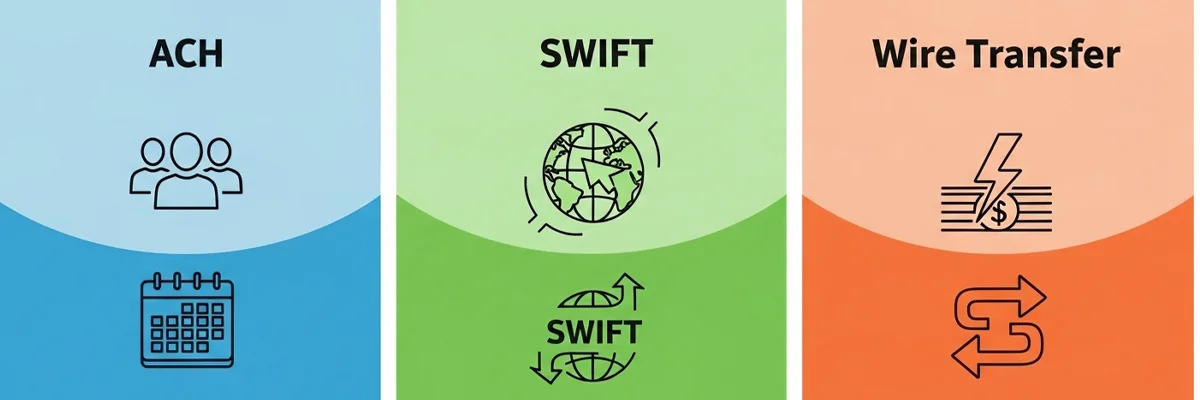
ACH stands for Automated Clearing House. Think of it as the everyday workhorse of the American banking system. It’s the technology behind direct deposits, bill payments, and most bank-to-bank transfers within the United States.
When your supplier in the U.S. receives a direct deposit from their payroll, that’s ACH. When you pay a subscription or utility bill online from a U.S. account, that’s ACH too. It’s reliable and runs in the background of nearly every domestic transaction in America.
How ACH Works
ACH transfers work by batching transactions together and processing them at set intervals throughout the day. Your bank or payment app that supports this sends a request through the ACH network, the funds are verified, and then the money lands in the recipient’s account. Standard ACH takes one to three business days, though same-day ACH is available for a small fee.
Since ACH is a U.S. domestic network, you can’t initiate an ACH transfer from a Nigerian bank account. However, if you’re using a platform like Clea that gives you access to U.S. payment rails, your payments can be settled via ACH on the other end. This is one of the reasons Clea is able to offer faster, cheaper vendor payments as your money reaches U.S.-based suppliers through the same low-cost network that American businesses use every day.
What is a SWIFT Transfer?
SWIFT stands for Society for Worldwide Interbank Financial Telecommunication. Despite the name, SWIFT itself doesn’t actually move money. Instead, it’s a secure messaging network that banks around the world use to communicate payment instructions to each other.
Think of SWIFT like the postal system for banks. When you send a SWIFT payment, your bank sends a coded message to the recipient’s bank saying, “Hey, we’re sending this amount to this account.” That message may pass through one or more intermediary banks before it reaches its destination, and each stop along the way can add time and fees.
How SWIFT Works
Every bank on the SWIFT network has a unique identifier called a SWIFT code (also known as a BIC code). To send a SWIFT payment, you provide your bank with the recipient’s SWIFT code, their account number (and in some countries, an IBAN), and the amount you want to send. Your bank sends the instruction through the SWIFT network, the intermediary banks process it, and eventually, the funds land in the recipient’s account.
SWIFT transfers from Nigerian banks are often slow, expensive, and unpredictable. Fees can stack up across multiple intermediary banks, exchange rates are rarely competitive, and payments sometimes get delayed or flagged for additional compliance checks.
What is a Wire Transfer?
A wire transfer is a broad term for an electronic transfer of funds from one bank to another. In the United States, domestic wire transfers are processed through systems like Fedwire (run by the Federal Reserve) or CHIPS (Clearing House Interbank Payments System). International wire transfers are typically routed through the SWIFT network.
The key distinction is that wire transfers are usually processed individually and in real time, which makes them faster than ACH but also more expensive.
When you initiate a wire transfer, your bank sends the payment instruction directly to the recipient’s bank (or through an intermediary). Unlike ACH, which batches transactions, wire transfers are processed one at a time. This means domestic wires can often settle on the same day, and international wires typically take one to two business days.
Wire transfers are best for urgent, high-value payments. If you’ve won a car at auction and need to pay within 24 to 48 hours, a wire transfer gives you the speed you need. It’s the standard payment method for international buyers on platforms like Copart and IAAI.
Side-by-Side Comparison: ACH vs. SWIFT vs. Wire Transfer
| ACH | SWIFT | Wire Transfer | |
| speed | 1-3 business days | 1-4 business days | Instant to next-day |
| transfer fees | Very low | High ($40 – $50) | Moderate to High ($35 – $40) |
| hidden fees | No, if using Clea | No, if using Clea | No, if using Clea |
| security | High | High | High |
| can you send from Nigeria? | Yes, if using Clea | Yes, if using Clea | Yes, if using Clea |
If your vendor needs a wire transfer, an ACH payment, or a SWIFT transfer, you can send it all from your Clea account – no need to juggle multiple banks or platforms.
Processing your payment with any rail on Clea looks like this:
- You fund your Clea wallet in Naira (Clea handles the conversion) or USD through a bank transfer.
- Add your beneficiaries by inputting your vendor’s payment details. If you’re paying a U.S. vendor via ACH or wire transfer, you’ll enter their routing number and account number. For a SWIFT payment, you’ll enter their SWIFT/BIC code and account number (or IBAN).
- Choose your payment rail.
- See your exact rate and fees. Input the amount you need to send, choose your preferred payment method, and Clea shows you the exchange rate, the transfer fee, and the total you’ll pay all upfront.
- Your vendor gets paid in your personal or business name, as it applies.
Pro Tip: You can compare the amount you’d save with Clea versus using a traditional bank right using Clea’s calculator.
The Solution for Nigerian Importers and Businesses
The thing about traditional banks is that they often make international payments slow, opaque, and expensive. FX limits, unclear exchange rates, rejected payments, and days-long delays are the norm, not the exception.
With Clea, you:
- Pay vendors in 150+ countries
- Get fast settlement
- Get fair exchange rates
- Have access to multiple payment options in one place
Clea helps you move faster and with more confidence.
Frequently Asked Questions
Is a SWIFT code the same as a routing number?
No. A SWIFT code (8–11 characters) identifies a bank internationally and is used for cross-border SWIFT transfers. A routing number (9 digits) identifies a U.S. bank domestically and is used for ACH and U.S. wire transfers. Different networks, different codes.
Can you cancel a bank wire transfer once it’s been sent?
Rarely. International wires have a roughly 30-minute cancellation window after confirmation, but it’s not guaranteed. Domestic U.S. wires settle in real time, making the window even shorter. Once the receiving bank accepts the funds, the transfer cannot be reversed.
How long does an ACH payment take to settle?
Through traditional banks, ACH transfers take 1–3 business days. With Clea, ACH payments typically settle in 2 – 5 hours, so you can pay any U.S. vendor from Nigeria and have the funds arrive the same day.
How can I pay shipping agents and suppliers in China or the UAE?
Clea supports payments to vendors in over 150 countries via SWIFT. If it’s a shipping company, parts suppliers, or trade vendors, you choose the payment method that fits the destination and your timeline, and pay directly from your Clea account.
Make Smarter Payments
With Clea