

IAA is one of the two big US salvage auctions Nigerians buy from, and it tends to run a little cheaper than Copart on similar cars. The catch is that IAA assumes you already know what you’re doing. The platform shows you the vehicles and all their details, but the decision and risk are yours.
The name itself is a clue to what you are dealing with. IAA stands for Insurance Auto Auctions, and most of the inventory comes from insurance companies releasing vehicles after a claim, alongside cars from banks, fleets, rental companies, and dealerships. So a lot of what you will browse is total-loss or damaged stock, which is exactly why the prices look the way they do.
If you have used Copart, IAA will feel familiar in places and different in others. The difference that matters most is how a sale closes, and there are several points along the way that can catch a first-time buyer off guard.
So here is everything you need to know about how to buy cars from IAAI as a Nigerian, laid out in the order you will work through it: opening the right kind of account, reading a lot properly, bidding, and paying for a car once you have won it. By the end, you should be able to navigate the auction with confidence and move from finding a vehicle to arranging its shipment to Nigeria.
What to Know Before You Buy from IAA
Cars are sold as-is: IAA does not guarantee the condition of any vehicle. What you see in the photos, the description, and the videos is what you are buying. There are no returns and no refunds.
IAAI sales are settled “on approval”: On IAAI, most lots have a seller reserve, which is the minimum the seller is willing to accept. When you place the highest bid, you have not automatically secured the car. The seller, frequently an insurance company, still has to approve the bid. They can accept it, send a counteroffer, or decline it.
The bid price is never your final cost: Your winning bid is only the starting figure. On top of it sit IAA buyer fees, service and gate fees, an internet or virtual bid fee, then inland transport to a US port, ocean shipping to Nigeria, and finally customs duty and clearing in Lagos. A car that sold for $6,000 can reach you at a very different cost. Budget for the full picture, not the headline bid.
Payment timelines are tight: Once a sale is finalised, you have a short window of a couple of business days to pay in full. Late payment attracts fees.
How to Buy Cars from IAA as a Nigerian (Step-by-Step)
Step 1: Register as a Buyer on IAAI
Go to IAAI.com. You can browse the inventory as a guest, but to place a bid, you need a registered and activated buyer account. There is a yearly registration fee of $225 at sign-up before you begin.
As a Nigerian, you fall under IAA’s international buyers, and you have two main paths.
Registering as a Public (Individual) Buyer
A Public Buyer does not need a business or dealer license. This is the simplest route for an individual importing one or a few cars. You provide your basic details and upload a valid government-issued photo ID, usually your international passport. IAA accepts image files up to 25 MB, and you can complete the form before your documents are reviewed, though you cannot bid until they are approved.
As a buyer, note that public buying is permitted in many US states but not all of them, and not every vehicle is open to the public. Some lots are restricted to licensed buyers. If a car you want sits in a restricted state or is reserved for licensed buyers, a public account alone will not get you in.
Registering as a Licensed Business Buyer
If you are buying for resale, running a dealership, or want access to the widest range of inventory, you need to register as a Licensed Business Buyer. IAA asks international business buyers for a copy of the business license, a notarized English translation of that license if it was not issued in English, and tax documentation where it applies. The company name on your registration must match your documents exactly, because a mismatch leads to rejection.
The Broker Route for Nigerian Buyers
A large number of Nigerian buyers skip direct registration and buy through a licensed broker instead. A broker already has access across IAA locations, including restricted lots, and can handle the bidding, payment, title, and shipping coordination on your behalf. IAA runs a Market Alliance and broker network in Nigeria. The trade-off is the broker fee, which becomes part of your total cost, so factor it in from the start.
Once your documents are submitted, IAA reviews them and activates your account, then emails you to confirm you are cleared to bid.
Step 2: Understand How the IAAI Platform Is Organised
Before you start searching, know how the site is structured, because IAAI groups its inventory. When you get comfortable with the navigation menu, the platform stops feeling overwhelming.
The “Vehicles” Menu (Grouped by Type)
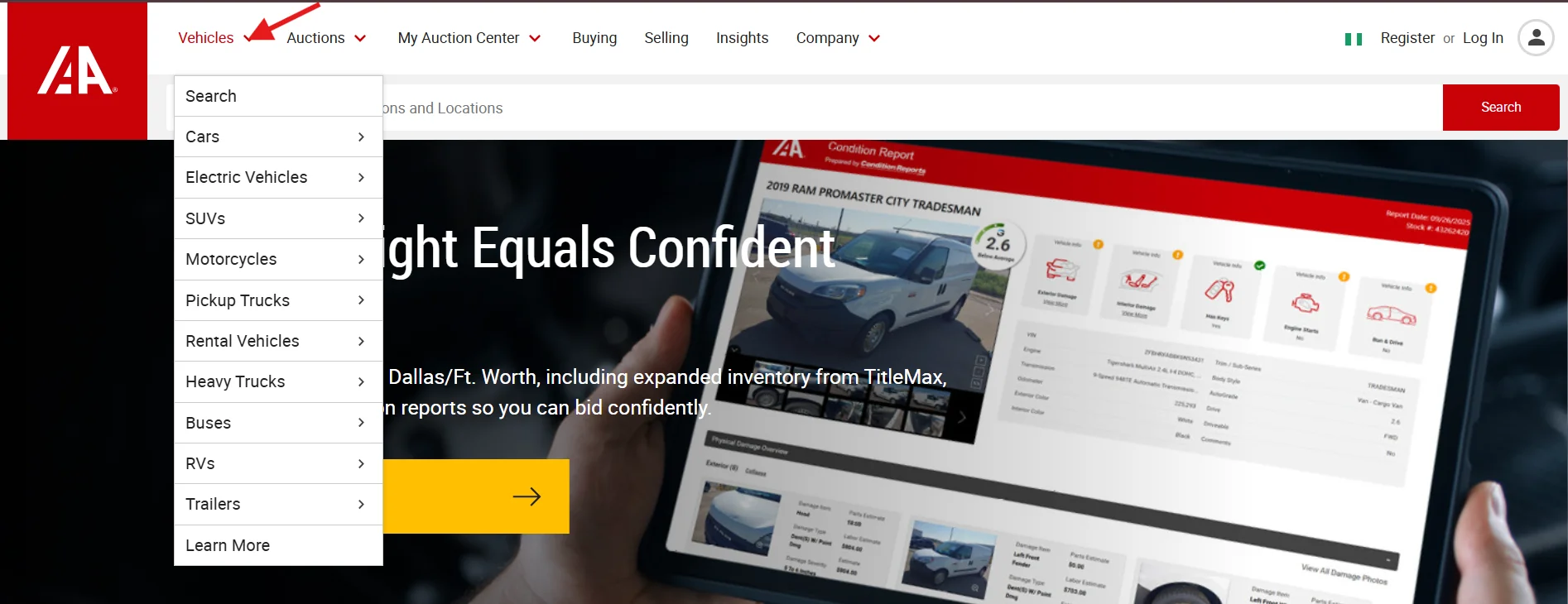
The Vehicles tab opens a dropdown that sorts inventory by the kind of vehicle you are looking for: Cars, EVs, Trucks, Motorcycles, SUVs, and more. This is the menu to use when you already know the type of vehicle you want. Selecting a category takes you straight into that segment of the inventory rather than the entire catalogue.
The “Auctions” Menu (Grouped by Sale Format)
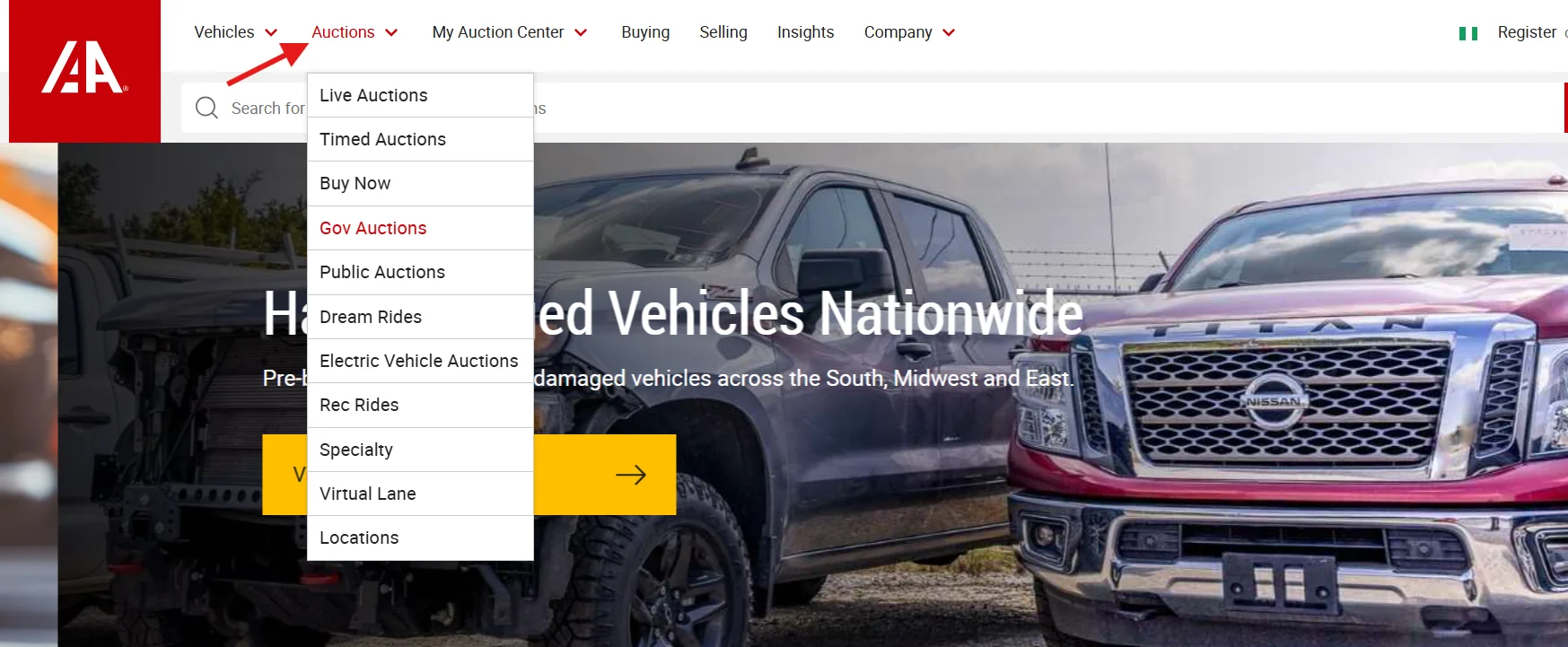
The Auctions tab opens a dropdown that sorts sales by how and when they run, mainly Live, Timed, and Public auctions, among others. Each format works differently, and knowing the difference affects how you bid:
- Live Auctions run in real time through IAA’s online bidding platform, daily and tied to specific locations. Bidding moves quickly, with the familiar going-once, going-twice cadence, and moments to adjust your ceiling.
- Timed Auctions are fully online and automated. Each vehicle has its own countdown and closing time, and these lots typically open for bidding for about a day before they would otherwise go to a live sale. You set your maximum bid, the system bids on your behalf in increments, and you can see if the reserve has been met. When the countdown ends and the reserve is met, the highest bidder wins. One thing to note: once you commit a maximum bid in a Timed Auction, treat it as final.
- Public Auctions are sales where any registered Public Buyer can bid, limited to vehicles that are legally available to the public.
- Buy Now
Step 3: Search, Filter, and Study a Vehicle
With an active account and a sense of the layout, you can search properly. IAAI lists a large volume of vehicles at any time, so the skill is in filtering hard and reading each lot carefully.
How the Search Flow Works
Take the Cars category as an example. When you select Cars under the Vehicles menu, the platform first presents the top 25 makes. From there, you choose the specific brand you want, such as Audi, BMW, Ford, or Toyota. Selecting a brand narrows the inventory to that make, and you then refine further using the filters: year, odometer reading, model, damage type, title type, location, and more.
Be precise with these filters. If you want a 2019 to 2022 Toyota Camry, minor damage, under 80,000 miles, set exactly that. You can also sort by auction date so you see what is closing soon against what is weeks away.
Read the Vehicle Information and Description
When you open a specific lot, you reach its vehicle details page. IAA provides ChromeData specifications, a VIN decoder, high-resolution images, and Key Images showing the keys or fob. Read the damage description and study every photo angle. Before you bid on anything, run the VIN through a history service like Carfax or AutoCheck to see past accidents, title changes, and previous owners.
Understand the Start Codes
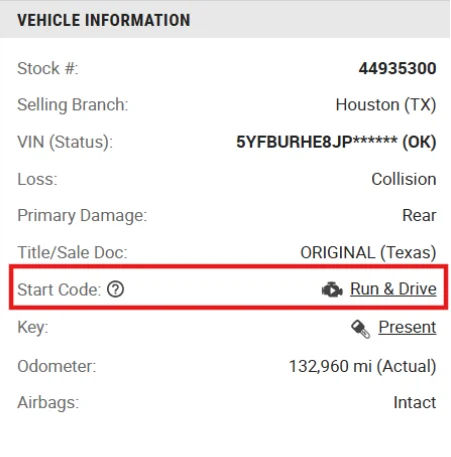
This is one area that first-timers misread, and it’s important because it tells you if the car moves under its own power.
- Run & Drive means the vehicle was verified to start, move, and stop under its own power at the yard. It is the strongest signal, though still not a guarantee.
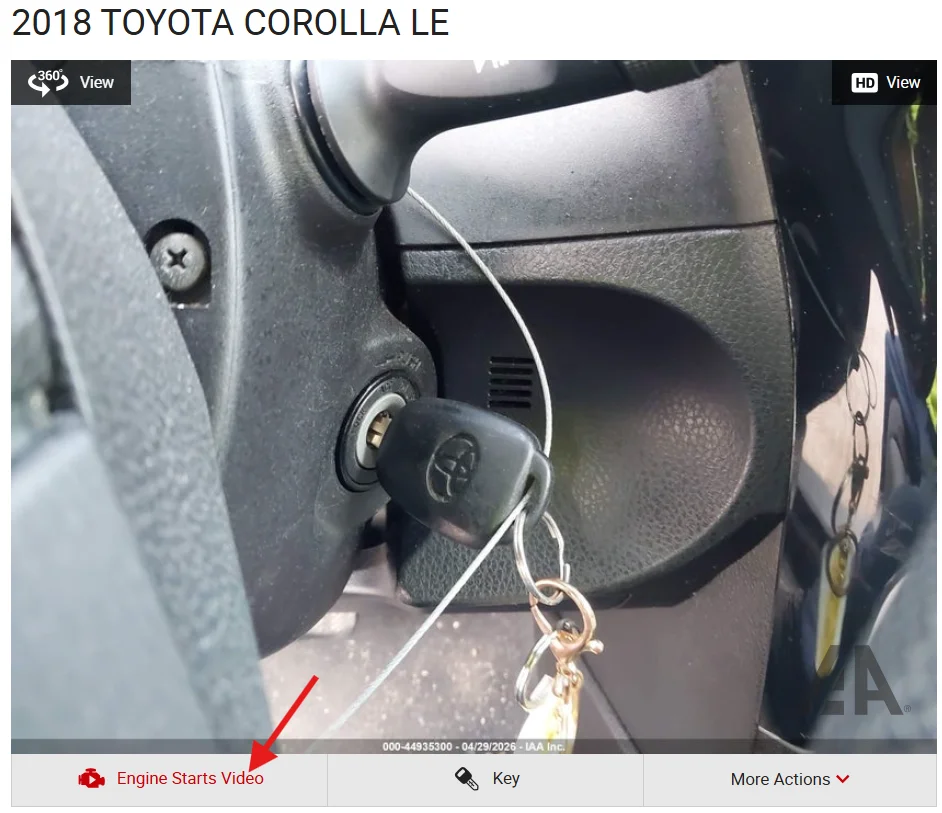
- Engine Start Program, sometimes shown as “Starts,” means the engine starts and idles, but it does not promise the car will go into gear or drive. A car can start and still refuse to move.
- Stationary indicates the vehicle may not start due to a damaged engine.
IAA Engine Starts is a short under-the-hood video, around ten seconds with sound, of the running engine. Watch and listen to it. A rough idle, a knock, or smoke in that clip tells you more than any still photo can.
Check the Sale Information: Know Who You Are Buying From
On the lot page, find the Sale Information section. This is where IAA shows the sale details, the title or document type, the sale status, and the seller.
When the seller is an insurance company, the car is usually a total-loss claim with documented damage, which tends to be more predictable. When the seller is a dealer or another reseller, apply more caution, because those cars can carry hidden damage or earlier rushed repairs that the photos do not always reveal. Knowing who is selling helps you read the rest of the listing with the right level of scrutiny before you commit money.
Once you have studied a lot and you are satisfied, you can add it to your Watchlist to track it, or move straight to a pre-bid.
Step 4: Place a Pre-Bid and Review Your Estimated Total
The Watchlist keeps all your shortlisted cars in one place and reminds you as their auction dates approach. It is also a way to learn the market. Track a few similar cars over a week or two, and you begin to understand what a fair winning price looks like for that model, rather than guessing.
When you are ready to bid but cannot sit through a live auction, possibly because of the time difference between Nigeria and the US, a pre-bid is the practical option.
A pre-bid is the maximum amount you are willing to pay, entered ahead of the auction. IAA holds it and bids on your behalf by proxy when the auction runs, raising your bid in small increments only as far as your set maximum. The highest pre-bid carries into the auction as a proxy bid.
Once you enter the amount you want to bid, IAA shows you an estimated cost that already layers its fees on top of your bid.
To understand exactly what makes up that number, read our breakdown of IAA fees for buyers. It walks through the buyer fee, the service and gate fees, and the other charges, so the estimate stops being a mystery, and your maximum bid is set with all of it accounted for.
Step 5: Bid in the Auction
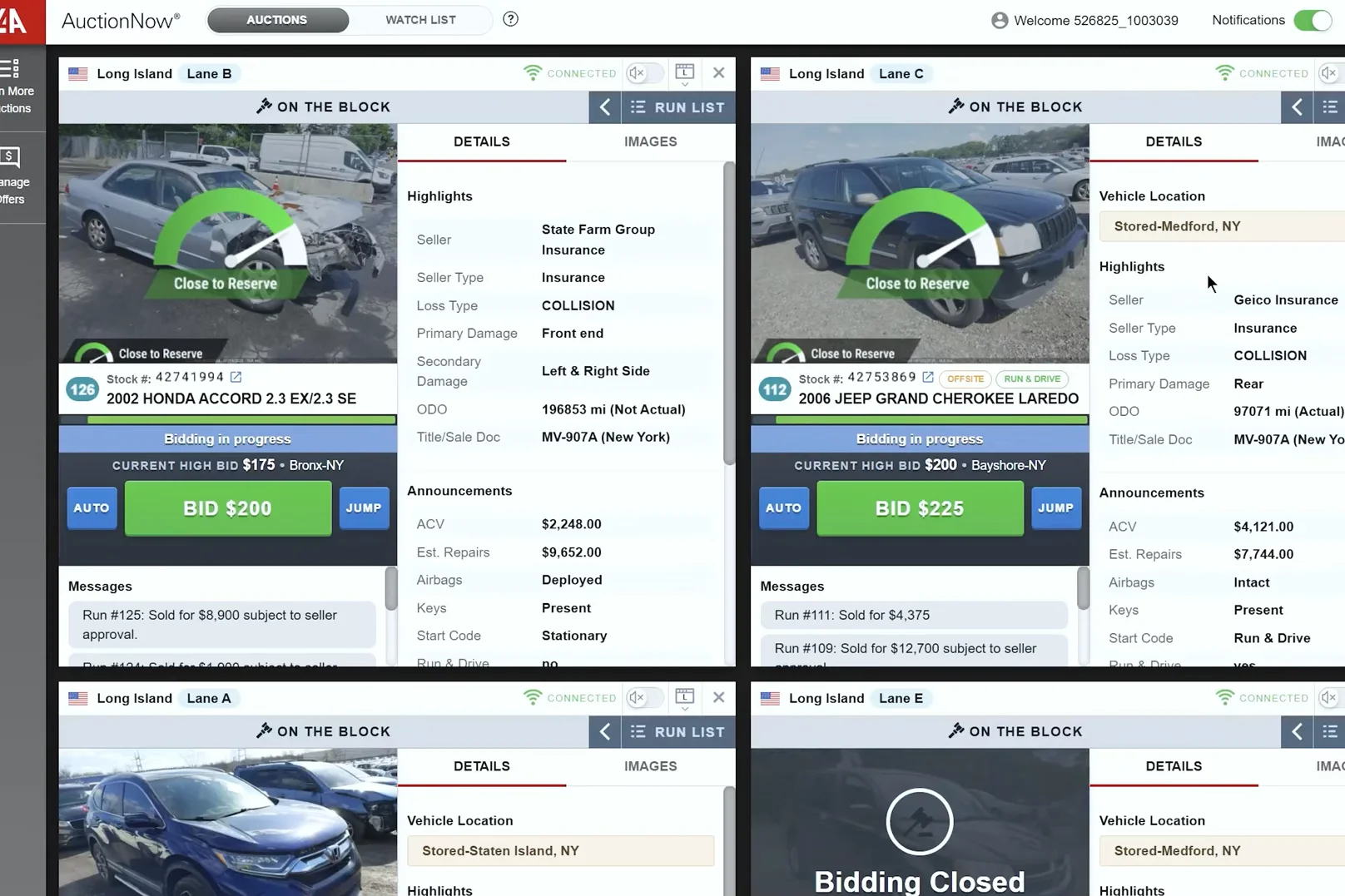
Depending on the lot, you will be bidding in a Live or a Timed auction, both of which you join from your phone or computer. The pace differs, with the live lane moving in fast increments and the timed format closing on a countdown, but the discipline is the same: decide your ceiling before bidding starts and hold the line. It is easy to be pulled into a bidding contest and forget that fees and shipping are still waiting on the other side.
Here is what happens once the bidding settles on your name.
If your bid meets or beats the seller’s reserve, the sale goes through, and the car is yours, subject to payment.
If your bid is the highest but falls below the reserve, you have not lost the car, but you have not won it either. The lot moves into a pending state, and the seller decides what to do next. They may approve your bid anyway, since sellers often accept a little under their reserve rather than relist and wait. They may send a counteroffer, which you can accept, decline, or answer with your own counter. Or they may reject it. You will see this activity in your account, so check it and respond within the time given, because a counteroffer expires.
Step 6: Pay for the Vehicle You Won
Once a sale is confirmed, the payment window opens, and you must pay in full within the short period IAA allows.
As a buyer in Nigeria, the recommended payment route is a wire transfer. On IAA, your wire is not attached to a specific car directly. The funds first arrive as account credit on your IAA profile, and you then log in and apply that credit to your vehicle and fees at checkout. The payment must come under the registered buyer name, meaning the account owner or an authorised bidder on the account. A wire from a name IAA does not recognise on your account causes delays.
This timing problem is exactly where many Nigerian buyers stumble. A wire transfer that clears too slowly can push you past the payment deadline and into late fees, or worse. If you want to pay IAAI without that anxiety, Clea lets you fund a US-dollar wire from Nigeria and pay IAA directly under your own name, quickly enough to beat the deadline. We cover the full process in our guide on how to pay IAAI from Nigeria without bank delays.
Step 7: Arrange Shipping to Nigeria
With payment posted, your car needs to leave the IAA yard. This happens in two legs – inland transport from the IAA branch to a US export port, then ocean or air freight to Nigeria. Watch the storage clock, because IAA gives only a few free days before daily storage charges begin, so coordinate your shipping agent early. Most Nigerian buyers work with logistics companies that run the US to West Africa route regularly and can handle pickup, the VehCAP certification, and the sea leg together.
Frequently Asked Questions
Can a Nigerian register directly on IAAI, or is a broker required?
Both are possible. You can register as an international Public Buyer using your passport and the $225 yearly registration fee, which works for inventory that is open to the public. For lots restricted to licensed buyers, or located in states that do not allow public buying, you go through a licensed broker. Many Nigerian buyers use a broker for access and convenience and pay the broker fee as part of their cost.
Do I need a dealer’s license to buy from IAAI?
Not for Public Buyer inventory. A license is required for restricted lots and for the full range available to Licensed Business Buyers.
What does “on approval” mean, and what if my bid does not meet the reserve?
“On approval” means the seller still has to accept your bid after the auction, because most IAA lots carry a seller reserve. If your highest bid is below that reserve, the seller can approve it anyway, send a counteroffer, or reject it. Watch your account after the auction and respond to any counter before it expires.
What happens if I win a car but do not pay on time?
You can lose the vehicle, forfeit any deposit, and face a relist fee, along with restrictions on your account. The payment window is short, so arrange your funds before you bid, not after you win.