
It’s painfully common in the Nigerian car importation space that, almost every week, vehicles are delayed, seized, or slapped with penalties at the port due to paperwork issues that could have been avoided with the right preparation.
And yet, most importers, especially first-timers, pour nearly all their energy into picking the right car, leaving paperwork as an afterthought. In reality, both deserve equal attention.
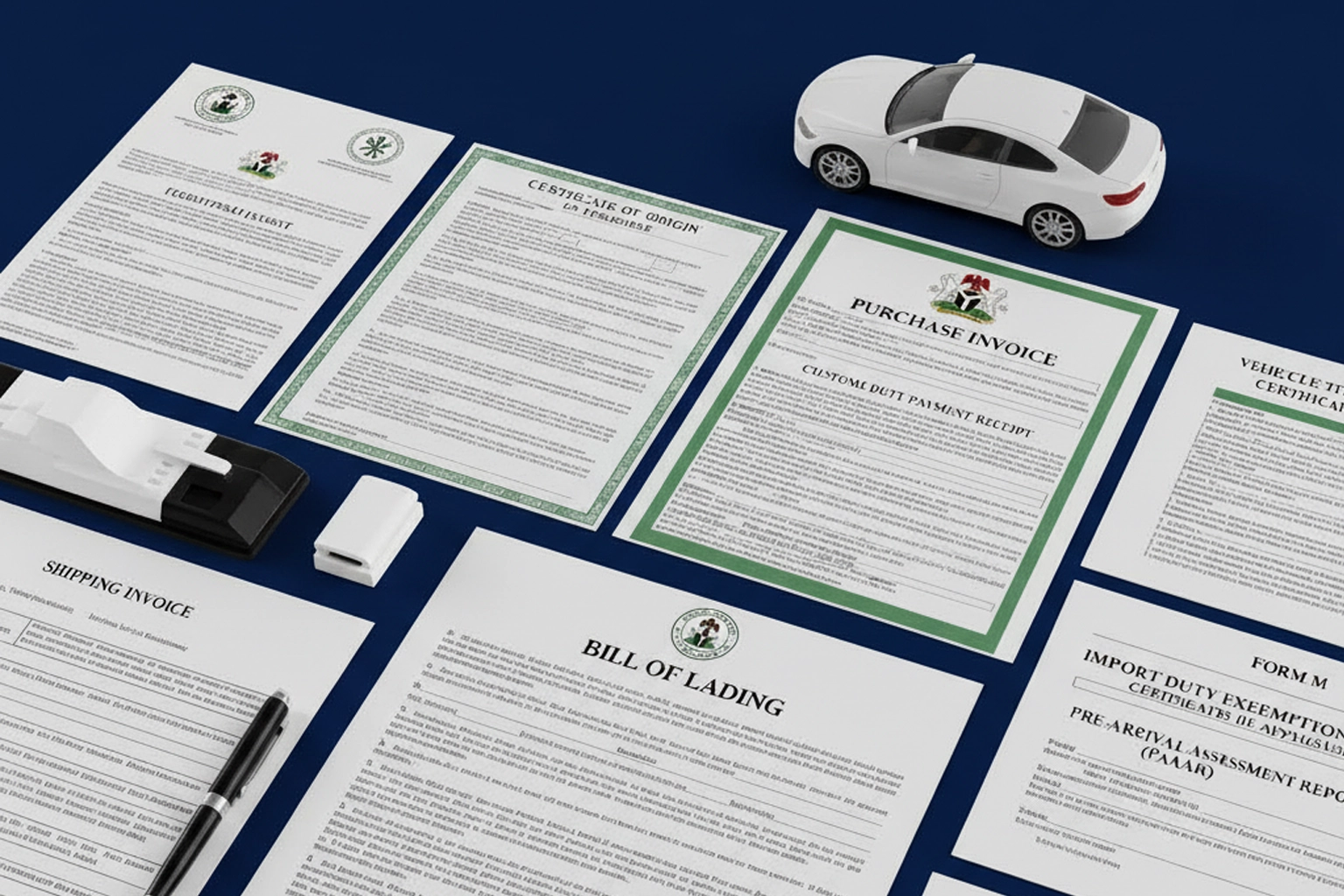
Let’s walk you through every single document you need to import a car into Nigeria. Each document is explained clearly – what it is and who issues it. This should be your reference guide.
Foundational Documents Needed to Import Cars to Nigeria
The import process in Nigeria doesn’t begin when your car arrives at the port. It begins long before the vehicle even leaves the country of origin. Several foundational documents must be in place before anything can move forward.
1. Form M (Import Declaration Form)
If there’s one document that sits at the heart of every importation in Nigeria, it’s Form M. Think of it as the government’s way of saying, “We know what you’re bringing into this country, and we’ve approved it.”
Form M is a mandatory import declaration form for all goods entering Nigeria, including vehicles. It validates your import transaction for foreign exchange purposes and is processed through an authorised dealer bank, which is simply a commercial bank licensed to handle international trade transactions. Your bank reviews the details of your import (what you’re bringing in, where it’s coming from, its value) and then submits the form electronically to the Nigeria Customs Service (NCS) for approval.
You cannot get a Pre-Arrival Assessment Report (more on that below) without an approved Form M. And without a PAAR, your car isn’t getting cleared at the port. It’s the first domino in the chain, so get it right.
2. Proforma Invoice
Before you pay for the car, your seller abroad provides you with an invoice. It’s more like a formal price quote that includes specific details such as the vehicle’s make, model, year of manufacture, VIN (Vehicle Identification Number), engine capacity, colour, and the agreed price.
This document is one of the attachments required when submitting your Form M application to the bank. It tells the Nigerian government exactly what vehicle you intend to import and how much you’re paying for it. Every detail on this invoice must match what ultimately appears on the Bill of Lading and the final commercial invoice. Any inconsistency, even something as minor as an incorrect colour description, can trigger delays.
3. Vehicle Title
The vehicle title is proof that the car you’re buying is legally owned by the person selling it to you. In the United States, for example, this document is commonly called a “clean title,” meaning the vehicle has no outstanding liens, hasn’t been reported as salvage (unless specified), and the seller has full legal authority to transfer ownership.
This document is especially important for cars purchased through auction platforms such as Copart or IAAI, where title status can vary. Nigerian customs officers and clearing agents will scrutinise this document closely. If the title has issues such as being branded as salvage or rebuilt without proper disclosure, it can complicate clearance or even lead to seizure.
The vehicle title is usually issued by the relevant motor vehicle department or authority in the exporting country (e.g., the DMV in the US).
Shipping and Transaction Documents
Once you’ve paid for the car and it’s ready to move, a new set of documents comes into play. These cover the shipping process and must be sorted out before or immediately after the car is loaded onto a vessel.
4. Bill of Lading (B/L)
The Bill of Lading is one of the most important shipping documents in international trade. It serves three purposes at once: it’s a receipt confirming the shipping company has received your vehicle, it’s a contract of carriage between you and the shipping line, and it’s a document of title, meaning whoever holds the original Bill of Lading has the right to claim the cargo at the destination port.
Your clearing agent in Nigeria needs the original Bill of Lading to begin any port-related processes. Without it, the terminal won’t release the vehicle. The details on this document (consignee name, vehicle description, port of loading, port of discharge) must match the information on your Form M and commercial invoice exactly.
It is always issued by the shipping line or freight forwarder handling the shipment.
5. Commercial Invoice
While the proforma invoice comes before the sale, the commercial invoice is the final, binding document issued after the transaction is complete. It states the actual purchase price, a full description of the vehicle, the buyer and seller’s details, and the terms of sale.
This is the document that customs uses alongside their own VIN-based valuation to assess how much duty you owe. Everything on it must be truthful and consistent with every other document in the chain. Under-declaring the value of a vehicle (to pay lower duties) is illegal and, if caught, leads to heavy fines, penalties, and possible seizure of the car.
6. Marine Insurance Certificate
Nigerian import regulations require that all imported goods, including vehicles, be insured. The marine insurance certificate covers your car against damage or loss during transit from the exporting country to the Nigerian port.
This isn’t optional. It’s a mandatory component of the CIF (Cost, Insurance, and Freight) value that customs uses to calculate import duties. The insurance should cover at least 110% of the vehicle’s value, and it must be obtained from an insurance company registered in Nigeria. Many importers make the mistake of getting insurance from a foreign provider, which customs won’t accept. This certificate is issued by a Nigerian-registered insurance company.
Pre-Shipment Compliance Certificates
These are the documents that confirm your car meets Nigerian standards before it’s shipped. They must be obtained in the exporting country and are non-negotiable for customs clearance.
7. SONCAP Certificate
SONCAP stands for Standards Organisation of Nigeria Conformity Assessment Programme. It’s a scheme introduced by the Federal Government of Nigeria to ensure that products imported into the country, including vehicles, meet minimum safety, quality, and environmental standards set by the Standards Organisation of Nigeria (SON).
For vehicle imports, the SONCAP certificate confirms that your car passed a pre-shipment standards inspection conducted by an accredited International Accreditation Firm (IAF) in the exporting country. This inspection typically covers items such as emission levels, safety features, and overall vehicle condition.
The SONCAP certification must be completed before the car is shipped. Many importers assume they can sort this out at the port, but that’s not how it works. Vehicles arriving in Nigeria without a valid SONCAP certificate will be refused clearance, and the importer will bear all costs associated with the delay, including re-exportation costs if necessary.
8. Certificate of Origin
The Certificate of Origin is a document that certifies the country where the vehicle was manufactured or substantially assembled. It’s used by Nigerian customs to verify trade classifications and determine whether preferential tariff treatment applies under agreements such as the ECOWAS Common External Tariff.
For used cars, this certificate also helps customs confirm that the vehicle’s origin matches the information declared on the Form M and other import documents. It’s one of those documents that seems straightforward until it causes a problem, usually when the origin stated on the certificate doesn’t match what’s on the commercial invoice or Bill of Lading.
Documents for Customs Clearance at the Port
Once your car arrives at a major port, likely Apapa or Tin Can Island in Lagos, the customs clearance process begins. You’ll need:
9. Pre-Arrival Assessment Report (PAAR)
The PAAR is an electronic document issued by the Nigeria Customs Service that provides a preliminary assessment of the duties and taxes you’ll need to pay on your imported vehicle. It’s generated before or shortly after the car arrives and is based on the details submitted through the Nigeria Single Window for Trade portal.
Your clearing agent typically handles the PAAR application using information from your Form M, Bill of Lading, commercial invoice, and other supporting documents. When everything aligns, a PAAR can be generated within 24 to 48 hours. But if there are inconsistencies in the documents, conflicting vehicle descriptions, mismatched values, or incorrect VIN details, the process stalls and your car sits at the port, accruing demurrage charges.
10. Single Goods Declaration (SGD)
The Single Goods Declaration is the formal customs entry document filed to declare your vehicle to the Nigeria Customs Service. It captures all relevant details of the import: the vehicle’s description, value, duty payable, and tariff classification under the Harmonised System (HS) code.
Your licensed clearing agent prepares and submits the SGD on your behalf. This is the document that triggers the physical examination of your vehicle by customs officers. Any errors or omissions in the SGD can lead to queries, re-assessments, or penalties, so accuracy here is absolutely essential.
11. Import Duty Payment Receipt
Once your PAAR is issued, you’ll know exactly what to pay. Under the ECOWAS CET (2022–2026), charges on used cars typically include a 20% import duty, 15% NAC levy, 7% surcharge, 0.5% ETLS fee, 4% FOB levy, and 7.5% VAT (applied on the total).
Altogether, this usually amounts to about 42%–55% of the car’s CIF value, excluding other costs such as shipping and clearing fees.
Once payment is made, the receipt is presented to customs as proof that all duties and taxes have been settled. Without this receipt, your car won’t be released.
Other Supporting Documents You May Need
Beyond the core documents listed above, there are a few additional items that may be required:
Bill of Sale: This is your proof of purchase, a document that records the transaction between you and the seller. You’ll typically need the Bill of Sale when booking your shipment with the shipping company, and it also serves as supporting proof of ownership alongside the vehicle title. Some clearing agents and insurance providers may request it as part of their verification process.
Packing List: If you’re shipping the car in a container (as opposed to Roll-on/Roll-off shipping), a packing list detailing the container’s contents is usually required. It’s a simple document, but must match the other shipping paperwork.
VIN Verification Report: A report from services like Carfax or AutoCheck that confirms the vehicle’s history, including accident records, mileage, title status, and prior ownership. While not a formal customs requirement, many clearing agents use it to cross-check the information on the vehicle’s title.
Letter of Authority/Power of Attorney: If you’re not personally clearing the vehicle at the port and have appointed a clearing agent to act on your behalf, a formal letter authorising them to do so is often required.
Tax Identification Number (TIN): You must be registered with the Federal Inland Revenue Service (FIRS) and have a valid TIN. This is a prerequisite for opening a Form M.
Importing a car into Nigeria demands attention to detail at every stage. The documents you prepare before shipment, the certificates you obtain, and the forms you file at the port must work together as a single, consistent, accurate package.
Work with professionals, double-check everything, and never assume you can just sort things out at the port. When importing cars to Nigeria, preparation isn’t just recommended; it’s essential.
Frequently Asked Questions
Do I need a SONCAP certificate for brand new cars, too?
Yes. The SONCAP requirement applies to all regulated products entering Nigeria, including both new and used vehicles. The vehicle must pass a pre-shipment inspection in the exporting country and receive the SONCAP certificate before it’s shipped. The only difference may be in the specific inspection route and documentation requirements, but the certificate itself is mandatory.
Is a Bill of Sale the same as a Bill of Lading?
No, and this is a very common point of confusion. A Bill of Sale is a proof-of-purchase document. It records that you bought the vehicle, who sold it to you, the price you paid, and the date of the transaction. A Bill of Lading, on the other hand, is a shipping document issued by the carrier (the shipping line or freight forwarder) after the car is loaded onto a vessel. The Bill of Lading serves as a receipt for the shipment, a contract of carriage, and a document of title that your clearing agent needs to claim the car at the Nigerian port.
How much does it cost to get a SONCAP certificate?
The cost varies depending on the certification route and the accredited firm you use. Generally, it costs between $350 and $400. Always request a full fee breakdown from the accredited firm before starting the process.
What do I need to get a Form M?
To open a Form M, you need four things in place first: a Certificate of Incorporation or business registration from the Corporate Affairs Commission (CAC), registration with the Federal Inland Revenue Service (FIRS), a valid Tax Identification Number (TIN) linked to an active email address, and a bank account. Once those are sorted, you submit the e-Form M application to your bank along with the proforma invoice from the vehicle seller, a locally sourced marine insurance certificate, and the relevant regulatory certificate. The bank reviews and submits it to the Nigeria Customs Service, which typically approves or rejects it within one working day.